Your Training Sessions Are Failing Before They Even Start — Here's Why
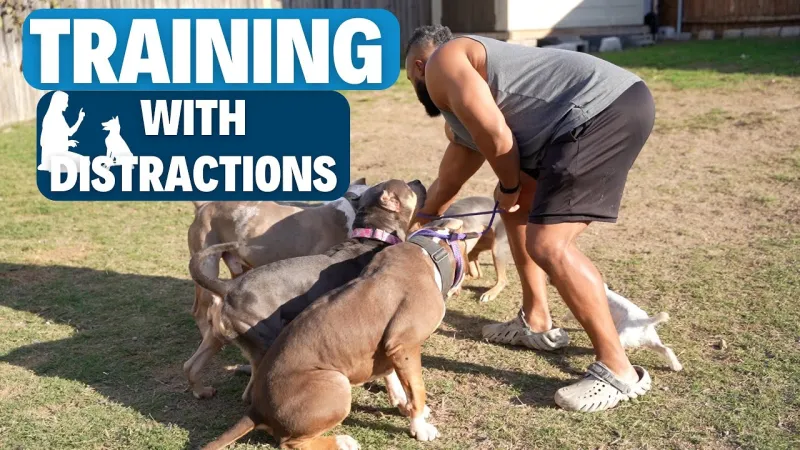
Photo: dog distracted outdoors training backyard overstimulated, via i.ytimg.com
You've got the treats. You've got the clicker. You've watched the videos. And yet your dog stares at you like you're speaking a foreign language the moment you step outside to train. Sound familiar?
Here's the thing: it might not be your technique at all. It might be your environment.
Dogs experience the world in a fundamentally different way than we do, and when their senses are firing on all cylinders — processing sounds, smells, and sights that we can't even register — asking them to focus on a "sit" command is a little like trying to solve a math problem at a rock concert. Something's gotta give.
Let's break down what's actually going on inside your dog's head, and more importantly, what you can do about it.
How Dogs Process the World (It's Not Like Us — At All)
Dogs have roughly 300 million olfactory receptors in their noses. Humans have about 6 million. That means your dog's nose is processing an almost incomprehensible volume of information at any given moment — who walked through the yard, what the neighbor's dog had for breakfast, whether the squirrel from Tuesday is still around.
On top of that, dogs can hear frequencies up to 65,000 Hz. We max out around 20,000 Hz. That low hum from the air conditioner two houses down? Your dog hears it clearly. The mailman's truck idling at the end of the street? Crystal clear.
And while their color vision is more limited than ours, dogs are incredibly sensitive to movement. A leaf blowing across the yard, a kid on a bike half a block away, a flag rippling in the wind — all of that registers as potentially significant information that needs to be processed and evaluated.
When you add all of this together, a seemingly quiet backyard can actually be a sensory thunderstorm for your dog.
Signs Your Dog Is Overstimulated During Training
Before you can fix the problem, you need to recognize it. Overstimulation doesn't always look like a dog losing their mind. Sometimes it's subtle. Watch for:
- Scanning behavior — your dog's eyes keep darting away from you, tracking movement or watching for threats
- Nose-to-the-ground fixation — they can't stop sniffing no matter how good your treats are
- Yawning or lip-licking — these are classic stress signals, not boredom
- Inability to take treats — when a dog is over threshold, they often won't eat even their favorite food
- Slow or incomplete responses — they're not ignoring you; their brain is just juggling too many inputs
If you're seeing two or more of these during a training session, your dog has likely hit their sensory ceiling and you're both just spinning your wheels.
The Backyard Problem Nobody Talks About
The backyard is almost every dog owner's default training spot. It's convenient, it's fenced, it feels safe. But for a lot of dogs — especially those who haven't been systematically desensitized to outdoor environments — the backyard is one of the most distracting places on the planet.
Think about what's happening out there on any given afternoon: neighbors mowing, kids playing, birds calling, squirrels running the fence line, wind carrying scent trails from every direction. Your dog's brain is doing overtime just cataloging all of it.
This doesn't mean you should never train outside. Generalizing commands to outdoor environments is a crucial part of real-world training. But if your dog is still learning a new behavior, the backyard is probably not the right classroom.
Building a Training Environment That Actually Works
The goal isn't to eliminate all stimulation — it's to control how much stimulation your dog is dealing with at any given time. Think of it like adjusting the volume dial. You want it low enough that your dog can concentrate, and you gradually turn it up as their skills grow.
Start indoors. Seriously. A quiet room inside your home is one of the best places to introduce a new command or behavior. Low foot traffic, familiar smells, no unpredictable sounds. It's boring by design — and that's exactly the point.
Pick your timing wisely. Early morning and late evening training sessions outdoors tend to be quieter. Less traffic, fewer people walking dogs, less neighborhood activity overall. If your dog gets rattled by sensory input, those windows can make a real difference.
Use visual barriers. If you're working in a space where your dog keeps fixating on movement, block their sightlines where you can. A privacy fence panel, a parked car, even your own body positioned strategically can reduce visual noise.
Manage the scent environment. You can't control every smell, but you can avoid training right after you've used strong cleaning products, lawn chemicals, or anything else that might be particularly distracting to your dog's nose.
Build up gradually. This is the piece most people skip. Once your dog has a solid understanding of a command indoors, practice it in the garage with the door cracked. Then in the driveway. Then in the front yard. Then the backyard. Each step adds a little more stimulation, but your dog's confidence and focus build right alongside it.
High-Value Rewards Are Your Anchor
When you do need to train in a more stimulating environment, your reward game has to level up. The treat that works perfectly in your kitchen might not hold a candle to the scent trail of a rabbit that ran through the yard an hour ago.
For high-distraction environments, go for the good stuff — small pieces of real chicken, cheese, or whatever makes your dog's eyes light up like it's the best day of their life. The reward has to compete with the environment, and sometimes that means pulling out the big guns.
A Quick Note on Breed and Individual Differences
Not every dog has the same sensory sensitivity. Scent hounds like Beagles and Bloodhounds are going to be more nose-driven. Herding breeds like Border Collies may be hypersensitive to movement. Terriers are wired to track and chase. Understanding your dog's breed tendencies — and their individual quirks — helps you anticipate which type of stimulation is most likely to derail your sessions.
This isn't an excuse to give up on outdoor training or assume your dog "just can't focus." It's information. And information is how you build a smarter training plan.
The Magic Is in the Setup
At K9 Magic, we talk a lot about what happens during training — the techniques, the timing, the consistency. But some of the most powerful work you can do for your dog happens before the session even starts, when you're choosing where and when to train and how much you're asking their senses to handle.
Set your dog up to win. Create the conditions where focus is possible. Then watch how quickly "can't" turns into "absolutely can."
That's where the real magic lives.