Too Popular for Their Own Good: Training the Dog Who Loves Everyone But You (In That Moment)
Photo: USFWS Mountain-Prairie, Public domain, via Wikimedia Commons
You've done everything right. You socialized your puppy. You took them to the dog park, the pet store, the neighborhood block party. They love people, they love other dogs, and they are, by every measure, a social butterfly of the canine world.
And now you can't get them to make eye contact with you the second another dog walks by.
Welcome to one of the more underappreciated training challenges out there: the highly social dog whose greatest strength is also their biggest obstacle.
The Problem Isn't Bad Behavior — It's Biology
Before we get into solutions, let's be clear about something: a dog that goes bananas around other dogs isn't a broken dog or a stubborn dog. In many cases, it's a dog who did exactly what you raised them to do — develop a love for canine companionship.
The challenge is neurological. When a highly social dog spots another dog, their brain releases a cocktail of excitement hormones — dopamine, norepinephrine, the whole party playlist. That arousal response is powerful, fast, and, crucially, competes directly with the parts of the brain responsible for paying attention to you and following cues.
Think of it like trying to have a focused conversation with someone while your favorite song is blasting and your best friends are waving at you from across the room. The willpower required to stay focused is enormous — and your dog hasn't necessarily built that willpower yet.
This is different from reactivity rooted in fear or aggression. Socially-motivated distraction tends to look like lunging toward the other dog rather than away, vocalizing with excitement rather than alarm, and complete inability to disengage rather than escalating threat displays. Same chaotic energy, very different root cause.
Why Standard Distraction Training Falls Short
Most generic distraction training advice goes something like: "Practice in low-distraction environments and gradually increase difficulty." Solid advice in general — but for the socially-motivated dog, it misses a key piece.
For these dogs, other dogs aren't just distractions. They're the highest-value reinforcer in the environment. No treat, no toy, no amount of enthusiasm from you is going to automatically outcompete the pull of a potential playmate — at least not at first.
This means you can't just practice near other dogs and expect improvement through repetition alone. You need a more targeted approach that addresses arousal management, reinforcement value, and environmental structure simultaneously.
Strategy One: Work the Threshold, Not the Trigger
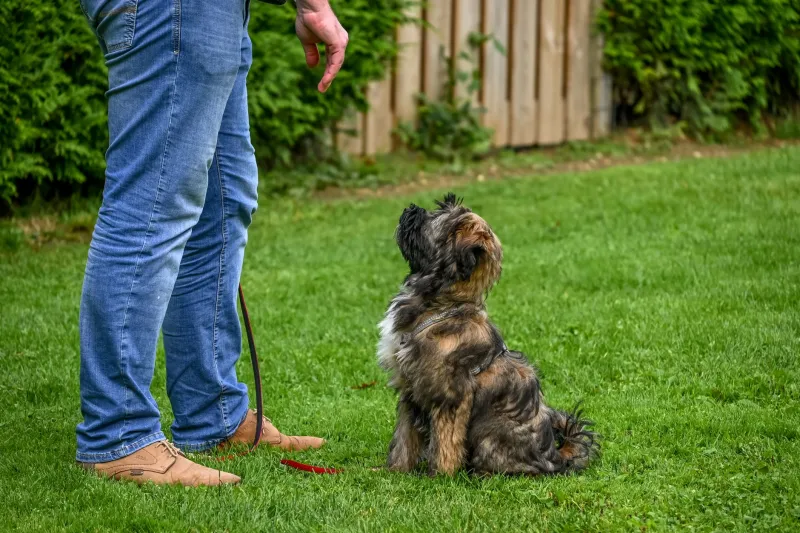
The concept of "threshold" is central to working with socially-distracted dogs. Your dog's threshold is the distance at which they can still function — still take treats, still respond to their name, still make brief eye contact with you — when another dog is present.
The mistake most owners make is training at or past the threshold, where the dog is already too lit up to learn anything. At that point, you're not training — you're just waiting for the other dog to leave.
Instead, find the distance at which your dog notices the other dog but can still check in with you. That might be fifty feet. It might be a hundred. Start there. Reward every glance back at you. Reward every moment of calm. Gradually — over days or weeks, not minutes — decrease the distance as your dog demonstrates they can stay functional.
This isn't about keeping your dog away from other dogs forever. It's about teaching their nervous system that other dogs in the environment don't have to mean immediate all-systems-go.
Strategy Two: Create a Training Zone Ritual
Highly social dogs benefit enormously from having a consistent pre-training ritual that signals "work mode" before you enter a distracting environment.
This might look like: leash on, five minutes of focused engagement in a calm space (some heel work, a few tricks, some hand touches), followed by a specific cue — maybe a tap on your leg or a cheerful "let's work" — that you use consistently when training begins.
Over time, that ritual becomes a neurological primer. You're essentially telling your dog's brain: "We're shifting into a different mode right now." Dogs are remarkably good at reading contextual cues, and a consistent pre-training sequence can help lower arousal before you ever encounter the social trigger.
Strategy Three: Use Other Dogs as the Reward
This one feels counterintuitive, but it's one of the most effective tools for socially-motivated dogs: make access to the other dog the reward for the behavior you want.
Here's how it works in practice. Your dog sees another dog. Instead of trying to lure them away with a treat, you ask for a sit or a look-at-me. The moment they give it to you — even briefly — you release them with "go say hi" and let them greet the other dog for ten to fifteen seconds. Then you call them back, reward the recall, and release again.
You're not fighting the social drive. You're channeling it. The other dog becomes a jackpot reward that your dog earns through compliance, and the recall becomes positively associated with the best possible outcome: more dog time.
This takes coordination (ideally a cooperative owner on the other end of the other dog's leash), but when it works, it works fast.
Strategy Four: Build a Real Reinforcement History
If your dog has never had a strong reason to pay attention to you in high-distraction environments, you can't expect them to summon that focus on demand. You have to build the reinforcement history first.
This means making yourself genuinely interesting — not just in training sessions, but in daily life. Spontaneous treats for eye contact on walks. Surprise play sessions when your dog checks in with you unprompted. Varied rewards so your dog never quite knows what's coming but knows something good always is.
The goal is to become a slot machine, not a vending machine. Predictable rewards train predictable behavior. Variable, exciting rewards build dogs who keep checking in because you're just that unpredictable and fun.
A Word on Group Classes
If your social butterfly is struggling in group training classes specifically, talk to your instructor about management options. Arriving a few minutes early to let your dog acclimate before classmates arrive, positioning yourself at the edge of the group, or using a visual barrier (a simple exercise pen panel works great) can all help reduce arousal enough to make the training session actually productive.
The goal isn't isolation — it's setting your dog up to succeed in the environment rather than spending the whole class in a state of overstimulation.
Social Is a Feature, Not a Bug
Here's the reframe that changes everything: your dog's social nature isn't the problem. It's a resource. Dogs who love other dogs and people are typically highly motivated, emotionally resilient, and easy to keep engaged — once you learn to work with the drive instead of against it.
The training challenge isn't to make your dog less social. It's to teach them that being social and being focused on you aren't mutually exclusive. That's the real magic — and yes, it's absolutely achievable.